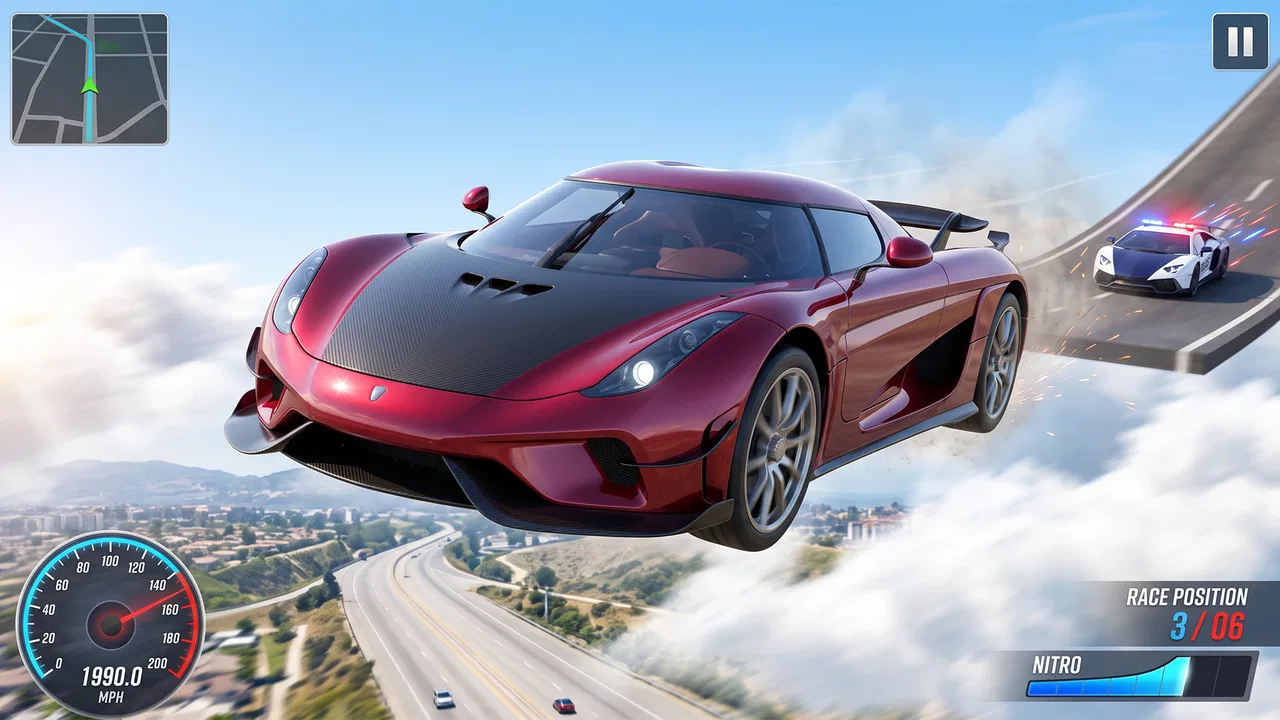
Real Car Racing Ultimate
- 4.6
- Rating
- 10.00M
- Installs
- Free
- Price

 Analysis by App-foxy
Real Car Racing Ultimate is a free racing game from Arcane Game Studio that aims for a more careful kind of driving than a simple arcade sprint. I spent time with it looking at the things that matter after the first few races: how progress feels, whether the driving rewards control, how much pressure the game puts on the player, and whether spending appears connected to fair competition. My overall impression is that it is most appealing to players who enjoy the idea of mastering streets and highways through precision rather than treating every race as a reaction-speed contest.
The game sits in the racing category and carries an Everyone age rating, so it is easy to recommend as a family-friendly option in terms of its listed audience. It is free to install, and its popularity is already substantial, with more than five million installs and an average rating of 4.6 from roughly ten thousand ratings. Those figures suggest that the basic concept has found a wide audience, although popularity alone does not tell me whether it will suit your preferred racing style.
What the driving experience asks from you
The central appeal is the focus on precision. Instead of presenting driving as nothing more than holding a button and watching a car accelerate, the game frames city streets and highways as places where positioning, timing, and restraint matter. That makes the experience more interesting for me during short sessions, because I have something specific to improve: smoother control, better anticipation, and fewer careless corrections.
You May Also Like

 Blood Strike: 2.5 Anniversary
Blood Strike’s Loadouts Turn Every Drop Into a Tactical Gamble
A close look at Blood Strike’s custom loadouts: how fast access to signature weapons reshapes its battle royale rhythm, rewards preparation, and narrows the gap between fights.

 Pandora - Music & Podcasts
Pandora’s Music Is Easy to Start, but Harder to Recover
Pandora’s strength is its low-effort path from a seed to a station. Its weak spot is how much confidence it asks you to place in connection, setup, and quiet recovery.

 8 Ball Pool
 Is Built on Rivalries, Rematches, and Routine
A close look at the rivalries, rematches, shared routines, and unanswered safety questions that turn a quick pool match into a persistent mobile community.

 Samsung Music
’s Quiet Strength Is Playing What You Already Own
Its reach comes less from spectacle than from dependable access to a personal library. That simplicity is both the app’s strongest retention engine and its ceiling.

 AccuWeather: Weather Radar
AccuWeather Review: A Quick, Clear Forecast for Everyday Decisions
For everyday plans, the best forecast is the one you can understand quickly. AccuWeather makes rain timing, radar, and local conditions easy to act on, with a few trade-offs.

 Hill Climb Racing
Why Hill Climb Racing Still Turns Crashes Into One More Run
A tiny car, a bumpy hill and one more upgrade: Hill Climb Racing keeps resurfacing because its simple chaos makes every near-miss feel personal.
More From Our News Desk



That approach also changes who will enjoy it. If you like racing games where every turn is an excuse to chase a cleaner line, Real Car Racing Ultimate gives you a reason to replay familiar situations. If you mainly want instant boosts, exaggerated jumps, and constant spectacle, the emphasis on controlled driving may feel less exciting. The store short description calls it “Real Car Racing,” but I would treat that as a description of its intended feel rather than a promise that it replaces a full simulation.
My most useful habit with this kind of game is to stop treating every mistake as a speed problem. When I enter a bend too quickly, braking later is not always the answer. A calmer approach—setting up earlier, avoiding a sharp steering correction, and leaving enough room for the exit—usually gives a more repeatable result. That is a small but important distinction: the game is better approached as a test of consistency than as a permanent attempt to drive at maximum aggression.
For a realistic everyday scenario, imagine having a few minutes before an appointment. A short racing session can work well because the controls are easy to understand immediately, while the precision goal gives the session a purpose beyond filling time. I would not choose it when I need a completely predictable offline distraction, because racing games can depend heavily on how their progression and competition systems are arranged. Still, as a quick focused break, its driving premise is more satisfying than a game that asks me only to tap through repeated straight lines.
Progress feels better when you set a narrow goal
I recommend approaching each session with one improvement target instead of trying to perfect everything at once. You might concentrate on entering corners more smoothly, keeping a steadier line on highways, or reducing unnecessary steering movements. This makes the game feel less demanding and helps reveal whether your improvement comes from genuine control rather than luck.
A second useful technique is to separate learning a route from chasing a result. On an early attempt, I would focus on remembering where the road changes direction and where traffic or road layout might require attention. On the next attempt, I would work on pace. Combining both jobs immediately can create the familiar racing-game frustration where one mistake ruins the run and teaches very little.
This is also where the game may divide players. Some people want a clear stream of rewards and rapid access to new content. Others are happy to repeat a challenge until their driving becomes cleaner. Real Car Racing Ultimate is more naturally suited to the second group, at least in spirit. The precision theme gives repetition a purpose, but players who dislike replaying sections may find that purpose too thin.
Free does not automatically explain the spending experience
The game is free, which removes the biggest barrier to trying it. However, a free download does not by itself tell me whether optional purchases are present, how progression is balanced, or whether spending changes the pace of advancement. I would not assume that the game is generous or aggressive without seeing those systems clearly in practice. For a careful recommendation, that distinction matters more than the word “free.”
My practical advice is to play long enough to understand the normal progression before considering any purchase. Notice whether you are enjoying the driving itself or simply trying to get past a restriction. If progress feels satisfying without spending, there is no reason to buy anything merely because the game presents an offer. If the experience begins to feel like a repeated demand rather than a racing challenge, that is a good point to stop and reassess.
Parents should use the Everyone rating as a helpful starting point, but I would still check the device’s purchase protections before handing the game to a child. An age rating describes the intended content audience; it does not replace household controls around downloads or spending. That is a general precaution, but it is especially sensible for any free game where the installation cost is not the whole story.
Fairness, competition, and the questions I would ask before committing
Fairness is difficult to judge from the driving concept alone. A precision-based racer can feel fair when success comes from choosing a better line and controlling the car more consistently. It can feel much less fair if progress or competitive results are heavily influenced by advantages that are not earned through driving. I found the game most convincing when I treated its streets and highways as skill tests, but I would avoid promising a fully level competitive field without clearer evidence about its purchase and multiplayer systems.
That uncertainty does not make the game untrustworthy; it simply changes how strongly I recommend it. For solo-minded players, the important question is whether the driving remains enjoyable without pressure to spend. For competitive players, the standard is higher: they need confidence that results reflect control, timing, and route knowledge rather than access to paid advantages. I would place Real Car Racing Ultimate in the “try it and evaluate the balance yourself” category rather than giving it an unconditional endorsement for serious competition.
One way to protect your own enjoyment is to define a stopping point before a difficult session. For example, decide that you will make several focused attempts and then leave if the challenge stops teaching you anything. This prevents the common cycle of repeating a race while becoming more impatient, which can make a fair difficulty curve feel unfair. It also helps you identify whether the game is asking for better technique or merely more time.
Another useful test is to compare your results after changing only one driving habit. If a calmer entry into a corner produces a better run, that is evidence that the game rewards control. If improvement seems unrelated to what you do behind the wheel, I would be more cautious about investing time or money. This kind of self-test is more informative than a quick first impression because it connects the result to an observable choice.
Who should try it, and who should look elsewhere
I would suggest the game to someone who enjoys car-themed challenges but does not want the complexity of a dedicated simulation. It is also a reasonable choice for players who like short sessions with a clear skill objective. The combination of a free entry point, an Everyone rating, and a focus on city and highway driving makes it approachable for a broad audience.
I would be less likely to recommend it to a player seeking a deep garage-management experience, a detailed motorsport career, or a guaranteed competitive environment. Those players may prefer a more specialized racing title whose main strength is licensed competition, extensive tuning, or transparent online ranking. Real Car Racing Ultimate sounds more attractive when the act of driving is the main event.
It is also not the right choice for someone who dislikes repeating a route. Precision games often ask you to learn through small corrections, and that can feel slow if your ideal racing experience is about constant novelty. In that case, a more arcade-focused alternative may provide faster variety and a more forgiving relationship with mistakes.
Device compatibility and practical expectations
The listed minimum operating-system requirement is Android 7.0, so the game is available to a wide range of Android devices rather than only recent phones. Even so, compatibility is not the same as identical performance. Older hardware may provide a less comfortable experience in a racing game, especially when precise steering is central to success. I would keep the device cool, close unnecessary background apps, and make sure there is enough free storage before starting a longer session.
The current version is 1.0.6. That gives me a useful point of reference when comparing impressions with another player, because two people using different versions may not experience exactly the same behavior. I would update through the normal app channel before judging controls or stability, then spend a little time learning the handling instead of deciding after one awkward corner.
The developer is Arcane Game Studio, and the game was released on November 9, 2025. Those details place it in a relatively early stage of its public life, which makes it sensible to judge the current build while leaving room for the experience to develop. I would not treat future changes as guaranteed, but I would pay attention to whether later updates improve clarity around progression, competition, and spending.
What I would check before spending time or money
My first check would be whether the basic driving loop remains enjoyable when I ignore every optional prompt. Can I practice a route, improve a mistake, and feel that the result came from my input? If yes, the free version has a solid foundation for me. If no, purchases are unlikely to solve the underlying problem, because they would not make an uninteresting driving model more engaging.
Next, I would watch how the game handles failure. A fair racer gives me a useful reason to try again: I entered too quickly, turned too sharply, or failed to prepare for a road change. A frustrating racer leaves me unsure what went wrong. This is one of the most important hidden qualities in a precision game, and it is worth paying attention to even though it is not captured by the short store summary.
Finally, I would separate convenience from competitive advantage. A purchase that saves time is different from one that changes who can win. Since the available purchase details do not establish those distinctions here, I would make no claim that spending is necessary or harmless. I would simply recommend that players decide according to their own boundary: spend only when the value is clear, optional, and comfortable, never because a difficult race has made them impatient.
My trust verdict after looking beyond the first race
The strongest reason to try Real Car Racing Ultimate is its focus on controlled driving rather than empty speed. That gives the game a recognizable identity and creates room for real improvement. I like that the concept can turn a short session into practice: choose one weakness, make a small adjustment, and see whether the next run feels cleaner.
Its limitations are equally important. The free price makes testing easy, but it does not answer every question about progression or purchases. The Everyone rating makes the game approachable, but it should not be confused with a guarantee that every family will want the same spending setup. And the racing premise suggests skill-based play, while the available information does not justify a firm claim about competitive monetization or online fairness.
For me, that leads to a measured recommendation. I would install it if I wanted an accessible Android racing game built around city streets, highways, and precision. I would give it a fair trial without spending, use focused practice goals, and judge the experience by whether my driving decisions clearly affect the outcome. If that relationship feels consistent, the game can become a satisfying casual racer. If I wanted deep simulation systems or fully documented competitive rules, I would choose a more specialized alternative instead.
Real Car Racing Ultimate earns a cautious recommendation as a free entry point for players who enjoy improving their control one run at a time. Its rating and install base show that many people have already given it attention, while its current version provides a clear starting point for new players. I would trust it enough to try, but I would keep my expectations grounded: enjoy the driving first, treat spending as optional until proven worthwhile, and let the fairness of your own results decide whether it deserves a permanent place on your phone.
FAQs for Real Car Racing Ultimate
01What are the minimum system requirements for Real Car Racing Ultimate?
Real Car Racing Ultimate requires Android 5.0 or iOS 11.0 and above. To ensure smooth gameplay, it's recommended to have at least 2GB of RAM and 500MB of free storage space. The game performs best on devices with a quad-core processor or higher. Make sure your device meets these specifications for the optimal experience.
02Does Real Car Racing Ultimate have multiplayer features?
Yes, Real Car Racing Ultimate offers a robust multiplayer mode where you can race against friends or players worldwide. You can join tournaments, participate in daily challenges, and climb the leaderboards. An internet connection is required for accessing multiplayer features, so ensure you have a stable connection to enjoy seamless racing.
03Are there in-app purchases in Real Car Racing Ultimate?
Real Car Racing Ultimate includes a variety of in-app purchases. These range from car upgrades and customization options to premium currency packs. While the game is free to download and play, these purchases can enhance your gameplay experience. However, all content can be unlocked through regular gameplay, albeit at a slower pace.
04How realistic are the graphics and physics in Real Car Racing Ultimate?
Real Car Racing Ultimate prides itself on delivering highly realistic graphics and physics. The game features detailed car models, dynamic lighting, and weather effects. The physics engine ensures that cars handle realistically, providing an immersive driving experience. Players can expect a visually stunning and lifelike racing experience.
05Is Real Car Racing Ultimate suitable for younger players?
Real Car Racing Ultimate is rated for ages 10 and up. The game involves competitive racing with realistic crash effects, but it doesn't include any inappropriate content. Parents may want to supervise younger players due to the presence of in-app purchases and online interactions in the multiplayer mode.
Pros
- Realistic graphics enhance gaming experience.
- Wide variety of cars to choose from.
- Intuitive controls for smooth gameplay.
- Multiple racing modes keep it exciting.
- Regular updates with new features.
Cons
- In-app purchases can be pricey.
- Some cars require grinding to unlock.
- Occasional ads interrupt gameplay.
- High battery consumption during play.
- Requires stable internet for multiplayer.

Real Car Racing Ultimate
Gallery